
Saturday, April 07, 2007

QotW10: The Simple 'Second Life'


My Very First ‘Second Life’
I felt quite disappointed seeing other classmates having so much fun in Second Life, teleporting to cool places while I was having problems accessing it from my home computer. Thus, I decided to use the computers in our SIM computer labs but those wouldn’t allow me to teleport either! Taking the last resort, I borrowed Benjamin’s lap top over the weekends. It worked fine at first...until I tried to TELEPORT. Yes, it hanged the lap top.

Sadly, my Second Life was spent and explored on the Orientation Island. Still, I tried to make the best of it and get some screenshots while watching my avatar drive cute vehicles, attempting to talk to strangers, getting shocked by other avatars falling from the sky then landing right in front of me and sitting on huge grey rats and then not knowing how to get up! It was really funny.

My Avatar: You Can Call Me “Nicki Cazalet

I was amazed at how many different characteristics of the avatar I was able to edit to my liking. Being rather boring, I decided to attempt to just create an avatar that looked like me. However, it was more difficult that I had expected! In other words, it is much easier to create an avatar that does not resemble your real appearance.

I edited nearly everything from skin color, height, hair length, and hair volume to clothing, thickness of lips and removing the eye shadow. I dressed myself in a top of my favorite color and put on a simple pair of three-quart jeans. Even after nearly 20 over minutes of editing the avatar’s appearance, I was left with something that still didn’t quite look like me. When I was done, I asked my classmate Wei Yang if it looked like me and he replied, “It’s O.K., but you have lesser hair volume.” And so, it was back to editing the avatar again! It was pretty fun in some sense. However, the final avatar did look much better than the default avatar which had way too much make-up on! Scary…


(UPDATED!! -- Successful teleporting! Finally.)

Screenshots:


Grand Prize: This is Nicki Cazalet posing as a DJ in some club area found in Osaka, Japan. I think this photo and place is really cool. I have always felt that being a DJ looks really fun, just that I've never tried it before. Well, not until Second Life...Thus, this is my favorite place I've chosen!


Second Prize: This is Nicki Cazalet in beautiful Venice. Lovely...


Third Prize: This is Nicki Cazalet enjoying life in Hawaii...

All in all, Second Life was really pretty fun. Well, apart from the occasional lags and many technical problems. I also took a while to get used to navigating my avatar around the place. I think that if these areas could be improved on, it would make our second lives much better.

Labels:

Bonus Mission #2: Second Life is Not A Game

Before Kevin Lim’s class, I’ve never heard of Second Life. Due to that, I thought it was similar to Half-Life. Boy was I wrong.


What is Second Life?
Second Life is an Internet-based virtual world developed by Linden Lab which became popular in late 2006 and early 2007. On the Second Life website, a downloadable client program enables its users, also known as ‘Residents,’ to interact with one another using motional avatars. Second Life provides an advanced level of a social network service as Residents can explore the virtual world, socialize, participate in individual/group activities, and create/trade items and services from one another (“Second Life,” 2007).

Why is Second Life Not a Game?
After you have explored Second Life, you would come to notice that there is no main goal or way to win/lose in Second Life. Moreover, one is unable to virtually “die” in Second Life either. If Second Life was a game, we would expect it to have an aim/mission to accomplish, or a points system that can rank the Residents according to who has won or lost the most in Second Life.

In a way, Second Life resembles aspects of IMVU (Instant Messaging Virtual Universe).


[Source: IMVU. (2007). In: Wikipedia, the free encyclopedia.]
IMVU also uses 3-dimensional avatars that enable users to explore the area, interact with speech bubbles and carry out actions such as hugging or kicking one other. However similar these two programs may seem, it is not difficult to realize that Second Life contains much more facilities than IMVU.

In Second Life, users are there to interact using their 3-dimensional avatars and engage in activities that they would probably not be able to do in real life. An obvious one would be that users are able to fly in Second Life. Residents are also able to explore the map and teleport to different locations. These locations may only be virtual but some are representations of places in real life. For example, Mr. Alvin Loo spent US$1,650 to buy land on Second Life to create a virtual replica of Singapore called Lion City (Tham, 2007). This would enable other Residents to visit the virtual Singapore and explore how some real landmarks may look. To me, this could be seen as an act of giving, in some way. He spends the money to buy virtual land where other Residents are free to explore and enjoy. Therefore, this does not make Second Life a game.

Moreover, apart from being able to navigate and control one’s avatar to move around the virtual world, which is similar to how people control their characters while engaging in games such as Counter Strike or Halo, Second Life concentrates on enabling its users to personalize their avatars and socialize with one another. This further contributes to the idea that Second Life is not a game.

If Second Life is Not a Game, Then What Is It?

Second Life should be seen as a highly advanced social networking program. Unlike instant messaging programs where users communicate on windows through the exchange of text messages, Second Life provides a whole new virtual space for users to break beyond the lack of social cues on instant messaging programs to express themselves in a 3-dimensional world. In other words, Second Life has brought the world of online social networking a step closer to reality.

How Real Can It Get?
Life in Second Life pretty much reflects life in reality. Residents have to work to earn Linden Dollars (currency used in Second Life) or make items to sell to other Residents. In some cases, users have made real money out of selling their created items on Second Life.

In an incident related to World of Warcraft, one guild member had died in real life and his friends decided to hold a funeral for him inside the game. “The solemn affair was disrupted when a rival guild burst upon the unarmed mourners and slaughtered them mercilessly” (Levy, 2006). This emphasizes the fact that people are merging the happenings of real life issues together with that of the virtual world. This is significant in Second Life too.

We must remember: Although Second Life revolves around a virtual, or some may call ‘fake,’ world, the interactions between users are REAL.


References:

Levy, S. (2006). World of Warcraft: Is It a Game? Retrieved April 6, 2007, from http://www.msnbc.msn.com/id/14757769/site/newsweek/page/3/print/1/displaymode/1098/

Second Life. (2007). In: Wikipedia, the free encyclopedia. Retrieved April 6, 2007, from http://en.wikipedia.org/w/index.php?title=Second_Life&diff=120696573&oldid=120695922

Tham, Y. (2007, March 24). Second Life Virtual World Gets a Lion City. The Straits Times, p. 2.

Labels:

Saturday, March 31, 2007

QotW9: Citizen Journalism in Singapore


Some of us may have recalled watching The Arena (13th March 2007, 8pm on Ch5) when students debated on whether bloggers have become more influential than journalists. It is indeed a controversial issue as we have people who hate the idea of blogging and thus dislike people who do so, and others who embrace the latest hype over blogging. Citizen journalism, in most countries, has expanded greatly through the use of blogs.

What is Citizen Journalism?
Also known as “participatory journalism,” (“Citizen Journalism,” 2007) citizen journalism is the act of citizens “playing an active role in the process of collecting, reporting, analyzing and disseminating news and information” (Bowman & Willis, 2003). Essentially, it is not about what professional journalists are reporting to us in the news, but more of what we citizens view situations to be and what we believe. Thus, the term “we-media.” As Bowman and Willis (2003) have put it, “...journalism finds itself at a rare moment in history where, for the first time, its hegemony as gatekeeper of the news is threatened not just by new technology and competitors but, potentially, by the audience it serves.”


View this chart for the rise of citizen media:
(Bowman & Willis, 2005).

What is STOMP?


STOMP stands for Straits Times Online Mobile Print and was created by the Singapore Press Holdings. The website (http://www.stomp.com.sg/) allows citizens to engage in discussions on current affairs and interest topics through e-mailing them, or the use of mobile phones.

When you first load the STOMP webpage, you may be overwhelmed by the amount of pictures and some advertisements. Sure, it does catch one’s attention. A section called “Talkback” allows people to speak their minds and share their views/interests on any topic. Apart from that, STOMP has a “Court Room” page where information on court cases most talked about is posted. In addition, other sub-categories like “Singapore Seen,” “ST Foodies Club,” “Star Blog” and “Stink” add on to the features of this webpage. There are just so many things to be found on STOMP, you have to visit it to know what I mean.

The Question: Is STOMP an Ideal Form of Citizen Journalism for Singapore?
I would say that STOMP is indeed a form of citizen journalism for Singapore. Although Singapore may seem like an amateur to such a practice, the rate at which it is spreading throughout the country is rapid.

However, I would not claim that STOMP is an ideal form of citizen journalism for Singapore. A quick browse at STOMP would leave you with the impression that it is not a site that deals mainly with important current affairs but more of interesting, funny and light-hearted issues happening in the country. Sections that allow users to compete in talent contests and have ranking of most popular/talked about contest entries, plus STOMP eBay, give me the feeling that they are attempting to put too many things/features into one site. With a slight slip, STOMP might just fall into the category of a leisure website or a social networking site. Of course, for starters, STOMP has indeed succeeded in getting Singaporeans to actively participate in online discussions.

According to Dan Gillmor (2004), “As the pace of life has quickened, our collective attention span has shortened…The situation is made worse by the fact that most of us don’t stop long enough to consider what we’ve been told, much less seek out context, thereby allowing ourselves to be shallow and to be led by people who take advantage of it.”

How to Improve STOMP?


I think that to improve STOMP, features like STOMP eBay and MMSing Contests should be removed or placed on a separate domain. If the aim of STOMP is to encourage citizens to engage in discussions on current affairs and some other small talk, then these features are but a distraction that causes its users to stray from engaging in citizen journalism. Once again, this is only my opinion.

Also, since STOMP is a part of the Straits Times, people would be more cautious of what views and opinions they post. This is especially so for political issues. Users of STOMP should be taught to understand how to post opinions wisely and non-offensively while still maintaining their freedom of speech. This would then be a start to building a good foundation to encourage more citizen journalism here in Singapore. From gaining experience in STOMP, users may then branch out and set up their own blogs, thus engaging in citizen journalism.

In addition, it would be better if STOMP could cater to citizens of all ages rather than focus on attracting the younger crowd. All in all, we must remember that “A shallow citi­zenry can be turned into a dangerous mob more easily than an informed one” (Gillmor, 2004).


References:

Bowman, S. & Willis, C. (2003). We Media. Retrieved March 31, 2007, from http://www.hypergene.net/wemedia/download/we_media.pdf

Bowman, S. & Willis, C. (2005). Neiman Reports: The Future is Here, But Do News Media Companies See It? Retrieved March 31, 2007, from http://www.hypergene.net/blog/weblog.php?id=P327

Citizen Journalism. (2007). In: Wikipedia, the free encyclopedia. Retrieved March 31, 2007, from http://en.wikipedia.org/w/index.php?title=Citizen_journalism&diff=118429022&oldid=116903986

Gillmor, D. (2004). We the Media: Grassroots Journalism by the People, for the People. Retrieved March 30, 2007, from http://download.nowis.com/index.cfm?phile=WeTheMedia.html&tipe=text/html#chap1

Labels:

Friday, March 16, 2007

QotW7: Twit, Twitting, Twitted.


Introduction

To me, an online community is not very different from a real-life community. I picture it as a group of people who interact or associate themselves with one another probably due to shared interests or other reasons. The only things that are missing are physical presence of the community members and the lack of social cues.

An online community (aka virtual community) is “a group of people that may or may not primarily or initially communicate or interact via the Internet. Online communities have also become a supplemental form of communication between people who know each other in real life” (“Virtual Community,” 2007). However, do remember that community has a dynamic meaning (Fernback & Thompson, 1995).

According to Wellman and Gulia, a community is “more than the sum of a set of ties: its composition and network structure affects how it supplies companionship, supportiveness, information and a sense of identity” (1996).

With the emergence of online communities, people are able to interact electronically behind the use of pseudonyms. In an online community such as deviantART, forums are put within the site to enable its users to interact with one another in a forum respective to their interests. In most online communities, users have pseudonyms (but some may choose to use their real name; The WELL requires users to communicate using their real names), pictures/avatars, and users tend to gather in groups within the community or link to one another (if possible).

In online communities, members have the power to control the amount of information they release and create a selective self-presentation (Griffin, 2006). With an online identity comes the need for reputation management—“the process of tracking an entity's actions and other entities' opinions about those actions” (“Reputation Management,” 2007).

Here is a diagram that I made which shows examples of online communities. This list is not exhaustive.


Twitter

For this blog assignment, we were told to sign up for an account on Twitter.com. Here is my Twitter profile: http://twitter.com/mandycola


On the surface, to me, Twitter is like a massive tag-board. Let’s look at the different aspects of Twitter and see if it is an online community:

1) In a nutshell, Twitter users are able to hide behind a pseudonym as they post messages on what they are currently doing/reply to their friends’ messages. Messages on Twitter, however, are only allowed to be of 140 characters. This makes messages short and thus resembles that of a tag-board (usually found on blogs). In short, people choose to sign up for Twitter using either their real names/pseudonyms. Also, they are able to post short messages. In online communities such as forums, members also have pseudonyms and are able to post messages to allow interaction. In addition, Twitter users have avatars similar to that of online forum members and are able to customize their profile pages.

2) Twitter users are able to explore the list of other users and add friends to their list. These friends then appear on the profile page of one another. Here, we can see how Twitter allows its users to link to one another, possibly resembling smaller groups/cliques within the population. Thus, Twitter is similar to online communities such as blogs or MySpace where users can also link to one another and the links between users are also displayed on the blog/profile page. By definition, online communities often divide into cliques or form new communities (“Virtual Community,” 2007).

3) What kinds of messages do Twitter users post? In general, Twitter is to enable users to constantly/conveniently post updates on their whereabouts/what they are doing. Thus, in a way, messages on Twitter are like shortened versions of diary entries. You may think that this makes Twitter more of a blog instead, but don’t forget that blogs are also forms of online communities.

4) Not only do Twitter users post short messages available for viewing by their friends/public, they are also able to send “Direct Messages” to other users. This function allows users to socialize and converse about any other topic. Looking at social networking sites (another form of online community) such as Friendster, we see that Friendster members are also able to send private/personal messages to one another, which is usually how they get to socialize.

5) Twitter users are able to mark messages of other users as their “Favorites” which will also appear in a list accessible from one’s profile page. This function is alike that of the online social bookmarking service—del.icio.us. On del.icio.us, members create a list of their favorite bookmarks of any topic they like. Thus, the “Favorites” function of Twitter resembles that of del.icio.us (also an online community).


Conclusion


After studying the functions and aspects of Twitter, I would say that it is an online community. In detail, Twitter is like an online community where each of its functions resembles that of other existing online communities as I have pointed out previously. Recalling what our guest speaker Benjamin Koe (http://eok.net) mentioned: An online community is free, fun and open. Indeed, Twitter is FREE, FUN and OPEN. Not to forget, it is also highly ADDICTIVE.


Reference:

Fernback, J. & Thompson, B. (1995). Virtual Communities: Abort, Retry, Failure? Retrieved March 15, 2007, from http://www.rheingold.com/texts/techpolitix/VCcivil.html

Griffin, E. (2006). Social information processing theory of Joseph Walther. A first look at communication theory, 6th edition, pp. 142-155. McGraw-Hill Companies.

Reputation Management. (2007). In: Wikipedia, the free encyclopedia. Retrieved March 15, 2007, from http://en.wikipedia.org/w/index.php?

Virtual Community. (2007). In Wikipedia: the free encyclopedia. Retrieved March 15, 2007, from http://en.wikipedia.org/w/index.php?title=Virtual_community&diff=115277136&oldid=115277042

Wellman, B. & Gulia, M. (1996). Net Surfers Don’t Ride Alone. Retrieved March 15, 2007, from http://www.acm.org/~ccp/references/wellman/wellman.html
title=Reputation_management&diff=113442073&oldid=111797891

Labels:

Friday, March 09, 2007

QotW6: Do Not Disturb. Privacy Please!


What is “Privacy”?


“[1] Privacy is the ability of an individual or group to keep their lives and personal affairs out of public view, or to control the flow of information about themselves.
[2] Privacy is sometimes related to anonymity although it is often most highly valued by people who are publicly known.
[3] Privacy can be seen as an aspect of security - one in which trade-offs between the interests of one group and another can become particularly clear” (“Privacy,” 2007).

As defined by an anonymous person, “Privacy is to be left alone” (Sullivan, 2006).

To me, privacy is something that people provide each other out of respect. As individuals, we are entitled to our private lives that can be defined by what we choose to do, where we choose to go and the space around us. Speaking of personal space, a closely related term called “proxemics” introduced by Edward Hall describes the physical distances between people that can be categorized as public, social, personal and intimate as the distance gets shorter (“Proxemics,” 2007).


Proxemics explains that when people you are not comfortable with attempt to invade into your personal space, you feel offended and react to it. Similarly, when another person invades your privacy, you may feel offended too. In addition, privacy is not just about physical space; it consists of private information and personal issues. However, the extent to which we draw the line to define our personal “private space” depends on the individual - “To each his own.”

Negotiating My Own Privacy

Due to this assignment, I have attempted to create a brief list of things, regarding privacy, that I value.

The Dos...
Do ask me directly if there’s anything you want to know about me/my personal life.
Do request if you need to take a look at my notebook/computer files/copy homework.
Do respect my decision if I choose not to fulfill your requests.

And Don’ts...
Don’t peek at my e-mails/conversation windows/files.
Don’t try to check my SMS inbox.
Don’t use my accounts without my permission (identity theft).

After making this list, I feel like a total fusspot. However, I think that everyone should take a few minutes to make a similar list. It is through this that you clearly understand your tolerance for privacy issues. Never let anyone take advantage of you. If you feel like your privacy is being invaded, speak up!

Privacy in School

Spending 5 days a week in school surrounded by hundreds of other students, it is without a doubt that we may run into unpleasant privacy issues.

In secondary school, my classmate used to borrow my cell phone to “play games.” It was not long after that I found out she had been reading my text messages (because she carelessly told my best friend about it). I felt really horrible then. After knowing about it, I never did let her touch my cell phone again. From this, we can see that there are precautions that can be taken to protect your own privacy before mishaps occur.

On the more serious note, schools collect a lot of data and personal information regarding not only the students but their parents too. In an article by David Shi (2006), he discussed about protecting parents' and students' fundamental privacy rights including the “right of students to control their academic records - a federally protected right since 1972.”

As the class representative in junior college, I was given the task to collect the total family income of every student in my class to see who needed financial subsidy from the school. It seemed like a really easy task at first. Knowing that such information is very private, I approached each classmate instead of passing the list around. Some were very open about it while others openly requested those around them to look away before they wrote their family income down. Also, some even waited for everyone to leave the class.

“Privacy” – A Word Unknown to the Paparazzi

When it comes to privacy, it is inevitable to not think of its top invaders: The paparazzi.

Although this affects probably only the rich and famous, it is a clear example of the invasion of privacy. With the advent of the Internet, photographs and videos are easily available online. “The internet has vastly increased the opportunities for individuals to subject themselves to the demands of the personality market, resulting in ever increasing confusion and anxiety about how much of ourselves to reveal to strangers” (Rosen, 2004).

Free Image Hosting at www.ImageShack.us (Click to enlarge)

Recent hot gossip articles discuss the unglamorous shots of celebrities such Ashlee Simpson and Britney Spears. It seems as though the paparazzi have shifted from racing for pictures of scandal celebrity dates to horrible up-skirt photographs. With that, comes the hype over which female celebrity wears panties and which ones do not. Isn’t this way overboard?

Conclusion

Be it whether you are online or offline, you should learn to take precautions to secure your very own privacy. Privacy is yours to keep and protect. And, if you don’t wear panties, don’t become a celebrity.


References:

Privacy. (2007). In: Wikipedia, the free encyclopedia. Retrieved March 9, 2007, from
http://en.wikipedia.org/w/index.php?title=Privacy&oldid=113024808

Proxemics. (2007). In: Wikipedia, the free encyclopedia. Retrieved March 9, 2007, from
http://en.wikipedia.org/w/index.php?title=Proxemics&oldid=112973774

Rosen, J. (2004). The Naked Crowd. Retrieved March 9, 2007, from
http://www.spiked-online.com/Printable/0000000CA5FF.htm

Shi, D. (2006). Don’t Invade Student Privacy. Retrieved March 9, 2007, from
http://www.usatoday.com/news/opinion/editorials/2006-10-17-opinion-three_x.htm

Sullivan, B. (2006). Privacy Lost: Does Anybody Care? Retrieved March 9, 2007, from
http://www.msnbc.msn.com/id/15221095/print/1/displaymode/1098/

Labels:

Wednesday, February 21, 2007

QotW5: Online Identity - I Am Anyone I Want to Be


"But on the telephone line I am anyone, I am anything I want to be.
I could be a supermodel or Norman Mailer,
And you wouldn't know the difference.
On the telephone line, I am any height; I am any age I want to be.
I could be a caped crusader or space invader,
And you wouldn't know the difference, or would you?"

--Lyrics taken from Santa Monica (1997)
Written by Darren Hayes and Daniel Jones of Savage Garden



True enough, on the telephone, it is easy to assume any identity as long as your voice can pull it off. With the coming of the Internet, it has become even easier to be somebody you are not. Due to the anonymity of Internet users who are simply situated behind a computer screen, users can create a desirable image of him/herself on the Internet.

"One of the interesting things about the internet is the opportunity it offers people to present themselves in a variety of different ways. You can alter your style of being just slightly or indulge in wild experiments with your identity by changing your age, history, personality, physical appearance, [and] even your gender" (Suler, 2002).

Friendster - Personal Online Identity

An online identity that I own would be my online profile on Friendster (http://www.friendster.com/). Friendster, by now, needs little introduction as we all know that it is a popular online social networking site.
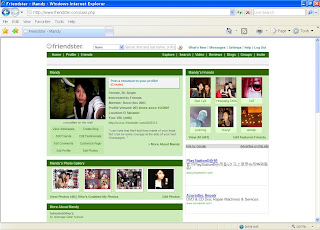


By viewing my profile page, you can find out a lot of personal data such as my name, age, location, school, zodiac sign, and how I look from my photographs. From the photographs, one can have a rough idea of where I usually hang out and how my close friends look like. Displaying of your last name is however, optional. Of course, there are users who choose to put up more/less detailed information about themselves. However, I have always set my profile as "limited to my friends only." This means that only those users whom I approve to be on my list can view my full profile. This is a method of protecting your online identity on Friendster.

Friendster is constantly upgrading their system to maintain its popularity and now it allows its users to post their favourite videos in the "Media box" section where most prefer to conveniently embed videos from YouTube (http://www.youtube.com/) into their Friendster profiles.

According to Joseph Walther's Social Information Processing Theory discussed by Em Griffin, people who are online have the opportunity to "make and sustain an overwhelmingly positive impression." They can present all their most attractive traits and accomplishments while filtering out the negative things. Thus, your online identity becomes a selective self-presentation (2006). So, if a stranger views your Friendster profile, he may develop a very different perception of you as compared to someone who already knows you personally.

Friendster - Reputation

Reputation is something that people tend to care a lot about. Of course, everyone wants to have a good reputation. It is the same for an online social networking site such as Friendster.

On Friendster, friends can leave testimonials and comments for one another which will appear on the profile page. The more positive and favorable testimonials/comments a person has may enable him/her to have a higher reputation in the "Friendster world." It also allows other viewers to get to know what others say about a particular someone. Here, we find an attribute discussed about the gift economy in my previous post: the testimonial section is highly fuelled by the principle of reciprocation.
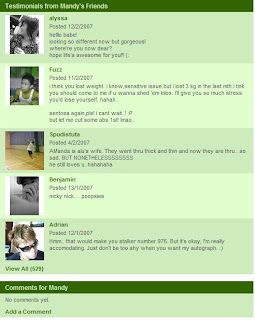


To increase one's reputation, he might want to carefully select the information he chooses to present about himself to create a far more positive identity than he really possesses. As stressed in the introduction, on the Internet, you can be anyone or anything you want to be, really. Therefore, be careful who you meet on Friendster. If you intend to meet him/her in person, remember that he/she might not turn out to be what you imagined him/her to be. Recall: the video posted on the COM 125 website (http://com125.wordpress.com/2007/02/13/qotw5-online-identity-reputation-deception/).

Another way to judge a person’s popularity or reputation on Friendster is to take a look at his number of profile views. On the profile page, there is a section that states "Profile Viewed: XXX times since 1/2/2007."

In addition, people tend to judge a person's reputation by how many friends he/she has on his Friendster account. I have several friends who actually own multiple Friendster accounts because they seem to have just that many friends to add. Plus, there is no law/rule that states you can only add someone who is really your friend. It is a personal choice. These people usually name their multiple accounts by volumes such as: John Lee I, John Lee II, John Lee III etc. With the creation of multiple accounts, these users have now become popular.

Identity Theft - The Attack of the Clones


With so much personal information easily found on someone's Friendster profile, it is extremely easy to steal his/her identity. On the Internet, "[m]any of the basic cues about personality and social role we are accustomed to in the physical world are absent" (Donath, 1996).

If someone wanted to steal my online Friendster identity, he could simply save and upload my photographs and replicate my personal information onto another user account. In addition, he could add the same friends I have on my original account since the list is easily accessible to him. From there, he could send messages, and much more, to my friends using my online identity.

If he is not discovered and dealt with, through computer-mediated communication (CMC), he could use increased flaming (hostile language that harms relationship on the Internet) in the messages sent to my friends while using my identity (Griffin, 2006). This would risk my relationship with my friends without my knowledge of it. "How harmful are such impersonations depends upon how defamatory the faked postings are and whether readers believe the false attribution" (Donath, 1996).

A true incident of identity theft on Friendster actually happened to my friend a few years back. Her profile details and photographs were duplicated onto another account and the "thief" added all of her friends on her original list and sent out a mass message telling them to delete her other account from their list, claiming that her original account was the fake account instead! When I received that message, I believed it and obediently deleted her real account from my list too. See the dangers of identity theft?

If you type "Britney Spears" or "Justin Timberlake" on Friendster's "User Search" function, you would be returned with hundreds of results, each containing photographs of these celebrities with a matching profile containing their name, age, occupation and hometown information accurately.
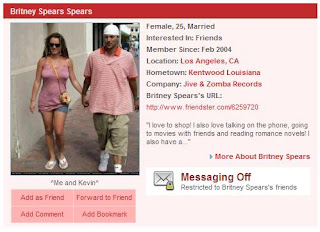

As celebrities, their personal data is easily accessible for anyone to replicate and assume the identity. However, it is less believable than assuming the identity of someone less famous, such as you and I. So, do not give out too much detailed information about yourself as you’ll never know if someone might become another you.


References:

Donath, J. (1996). Identity and Deception in the Virtual Community. Retrieved February 20, 2007, from http://smg.media.mit.edu/people/Judith/Identity/IdentityDeception.html

Griffin, E. (2006). Social information processing theory of Joseph Walther. A first look at communication theory, 6th edition, pp. 142-155. McGraw-Hill Companies.

Suler, J. (2002). Identity Management in Cyberspace. Journal of Applied Psychoanalytic Studies, 4, 455-460. Retrieved February 21, 2007, from http://www.rider.edu/~suler/psycyber/identitymanage.html


Labels:

Friday, February 09, 2007

QotW4: Gift Economy: The Future Tense of "I Give" is "I Take."


The Golden Rule: Do unto others as you would have them do unto you.


Most of us would have been taught the ethic of reciprocity at some point in life. It encourages us to be giving, yet it also leaves us anticipating that we would get something good in return. A gift economy can be closely tied to the concept of the Golden Rule.

"A gift economy is an economic system in which the prevalent mode of exchange is for goods and services to be given without explicit agreement upon a quid pro quo (the Latin term for the concept of "a favor for a favor"). Typically, this occurs in a cultural context where there is an expectation either of reciprocation--in the form of goods or services of comparable value, or of political support, general loyalty, honor to the giver, etc.--or of the gift being passed on in some other manner" ("Gift Economy," 2007).

After I read this week's topic, I immediately thought of an interesting line that my former lecturer, Dr. Andrew Sachs, had told the class: "The future tense of I give is I take." He took this from a book by Robert Cialdini. Indeed, a gift economy is well fuelled by the concept of reciprocation, a fundamental principle of the gift economy. According to Robert Cialdini, the rule of reciprocation "says that we should try to repay, in kind, what another person has provided us" (2001). Now, let us look at the gift economy in greater depth.

What are the "gifts" in a gift economy?


The "gift" part of "gift economy" should not be taken literally (Matzan, 2004). On the contrary to our common perception of a gift, gifts in a gift economy need not be tangible; neither must it be bought using money. This is a reason why most of us who are actually involved in a gift economy are unaware that we are!

Some examples of gifts are: content, advice, information, recognition and compliments. In addition, gifts are "intangible rewards, such as reputation, anticipated reciprocity and self-esteem" (Veale, 2004).

As the focus of this course is on the Internet, it is important to note that online gift economies are more on digital goods. "The setting is a (1)network of (2)digital (3)information, and each of these three features drives important changes. It is a world of information rather than physical objects" (Kollock, 1999).

Gift economy vs. Capitalist economy

A Capitalist economy generally refers to an economic system where the means of production operate for profit and are privately owned. Plus, it usually involves the trading of capital goods, labor and money ("Capitalism," 2007).

After understanding the concept of a gift economy, it seems as though it operates contrastingly to a capitalist economy, one that most of us are involved in now. However, according to Jem Matzan, "The gift economy concept does not interfere with capitalism at all, despite the general misunderstanding and mythology that surrounds it" (2004).

If we look at it in a different light, Matzan has a point. What we mostly gain from a gift economy are valuable intangible rewards that cannot be bought using money from a capitalist economy (such as reputation and self-esteem). Through a gift economy, people can interact and help one another, be it directly or indirectly. Thus, these two economies provide us with different types of benefits.

In relation to Lewis Hyde's "The Gift: Imagination and the Erotic Life of Property," Richard Turner states that "[g]ift exchanges create bonds and a sense of worth, while commodity exchanges require no necessary connection between the parties, either before or after the event, and characteristically have specific value. Often, a gift exchange becomes a commodity exchange when the transaction reaches beyond the boundaries of the gift community" (1989).

A gift economy?

"The Internet is still a gift economy" (Phillips, 1997). Indeed, when we use the Internet, we are participating indirectly in a gift economy. However, let us look at it on a smaller scale.

Recently, I joined an online art community called "deviantART". It allows me to share and view art works with thousands of others around the world. Their database of art works range from digital art, photography and traditional art to comics and fan art. These files are uploaded by members who are willing to share and give others a chance to view them. This community has been around for nearly seven years.

(www.deviantart.com)

The website has forums where users share information and interact while some even recruit artists by posting notices in the "Job Offers" section. Members share their interest for art and allow others to view their works. As an individual member, you can view the works of others and add them to your "favorites" list or leave them a compliment on their main page. As you give away these positive remarks as intangible "gifts," others will tend to link back to you and return you with a "gift" too. This way, deviantART members help to promote each other’s works through reciprocity, the principle of a gift economy.

By giving other members comments and increasing their page's viewership, we increase their self-esteem and status in the online community. All these are done in anticipation that we, too, would benefit from it somehow. Sometimes, these intangible rewards can also lead to tangible rewards. Popular art works are being put up for sale as prints on the website too.

From what I have explained, it can be told that deviantART is an example of an online gift economy. The best thing about this online community is that it is free to join and express yourself. In addition, the site encourages members to "give" by providing the option of protecting their works with Creative Commons.

In summary, deviantART fulfills the characteristics of a gift economy as:
1. Members willingly upload and share their works/files (The act of giving).

2. There is no explicit agreement upon a favor for a favor.
3. Members are driven by the principle of reciprocation.
4. Intangible rewards can be gained by participating in the community.

______________________________________________
Ralph Waldo Emerson – “The gift, to be true, must be the flowing of the giver unto me, correspondent to my flowing unto him.”
______________________________________________


References:

Capitalism. (2007). In: Wikipedia, the free encyclopedia. Retrieved February 8, 2007, from

http://en.wikipedia.org/w/index.php?title=Capitalism&oldid=106376748

Cialdini, R. (2001). Influence: science and practice (4th ed.). Boston, MA: Allyn and Bacon.


Gift Economy. (2007). In: Wikipedia, the free encyclopedia. Retrieved February 7, 2007, from,
http://en.wikipedia.org/w/index.php?title=Gift_economy&oldid=105681971


Kollock, P. (1999). The economies of online cooperation: Gifts and public goods in cyberspace. Retrieved February 7, 2007, from
http://www.sscnet.ucla.edu/soc/faculty/kollock/papers/economies.htm


Matzan, J. (2004). The gift economy and free software. Retrieved February 7, 2007, from
http://software.newsforge.com/software/04/06/04/142238.shtml?tid=150&tid=82


Phillips, E. (1997). Gift economy. Retrieved February 7, 2007, from
http://www.rewired.com/97/0602.html


Turner, R. (1989). Lewis Hyde, the gift: Imagination and the erotic life of property. Retrieved February 8, 2007, from
http://www.mla.org/ade/bulletin/N092/092054.htm


Veale, K. (2004). Internet gift economies. Retrieved February 7, 2007, from
http://futurepositive.synearth.net/2004/02/04

Labels:

Thursday, February 01, 2007

QotW3: To Download, Or Not To Download?


Who is stealing music?


I just bought an original copy of an XYZ band's album. James liked only one track off the album while listening to it in my car. When I got home, I ripped that song into an MP3 (MPEG-1 Audio Layer 3) format onto my computer and sent it to James through MSN (Microsoft Network) messenger. I shared my file with him.

If I did not send James the song, he would have opened his P2P (peer-to-peer) file sharing program and downloaded it off some other person's folder of shared files. Either way, XYZ band would not have sold an extra copy of their album to James. What seems to be the difference? I am allowed to rip the song off my copy of the album and into my MP3 player, but not let James have it. How do you actually control the circulation of MP3s?
_________________

With new models of MP3 players constantly being introduced into the market, it is without a doubt that MP3 players have replaced the popularity of MD (Mini Disc) and CD (Compact Disc) players. Now that nearly everyone around us owns MP3 players, take a step back and wonder: where are all these people getting their songs from?

File Sharing
"File sharing is now one of the most common on-line activities. More than 60 million Americans have downloaded music and the number of file sharers continues to grow rapidly" (Oberholzer-Gee & Strumpf, 2005).

P2P programs such as Napster and Warez P2P provide users with the convenience of downloading songs from a whole library of files put together by the shared folders of other users. Everyday, there are millions of file transactions being made through such programs. Thus, P2P programs have easily become the blame for any decline in record sales by the music industry. Is it really the cause?

CRIA (Canadian Record Industry Association) did a study on whether downloading music actually hurts record sales. From this research, they have found that "the largest downloading demographic is also the largest music buying demographic" and "dips in music sales have little to do with the availability of music on P2P services" ("Canadian Record Industry Association Study," 2006). This is a very interesting finding especially when it is coming from a recording company itself!

The Copyright Law
The purpose of copyright is mainly to benefit content creators while also encouraging creation of works. According to Kevin Brady, Attorney at Law, "It is generally accepted that a person may make personal copies (such as mix discs) of his/her legitimately-acquired CDs...However, the question of whether a person may give copies to others is not clear." In addition, copyright law states that no legal action may be taken against anyone who engages in "non-commercial" copying of musical recordings. The problem lies with the undetermined legal meaning of "non-commercial" (Brady, 2007). Technically, in reference to my anecdote, sending James the MP3 file is indeed non-commercial.

"...[T]he entertainment industry is arguing that the copyright law has not kept up with the digital world" -- Terence Smith, media correspondent (2005).

Just as the First Amendment grants people the freedom of speech, copyright law facilitates the monetary gains of producers and distributors. Therefore, if we stick to the current stringent copyright law, would we be neglecting the interests of the public?

Sharing = Promoting
When peers share digital music files through the Internet, they also help to promote the music. Recall the CRIA research findings, "The largest downloading demographic is also the largest music buying demographic."

Put the profit concerns of the music industry aside and look at the situation through the eyes of the public, the consumers. Allowing music files to be circulated freely on the Internet would give people the opportunity to sample the music. If it suits their liking, they could head down to a CD store and purchase it. If it does not suit their liking enough, the producers lose a chance of increasing their sales, but they increase the awareness of the singer.

"While downloads occur on a vast scale, most users are likely individuals who in the absence of file sharing would not have bought the music they downloaded" (Oberholzer-Gee & Strumpf, 2005). Objectively, it is equivalent to free promotion of their music!

The Music Industry
The number of sales made is a way to determine who is on the top of the charts. But let us face it; the music industry does not only make money from the sale of albums produced. Band merchandise, concerts and other special performances rake in the profit for those in the music industry. If a band is good enough to make it big, it will do so despite the existence of P2P programs or other forms of downloads.

Today, even with millions of music files being circulated, bands and singers who are good enough are still clenching the top spots in the market and making big bucks. As the world advances, big changes are constantly being made. Instead of fighting to protect their comfortable share of the economic proceeds, the music industry should change their mindset and welcome the new age of P2P file sharing.

Analysis:
Content creators (music industry) want to secure their profits while the public wants freedom of access to digital music files. Currently, the content creators are well protected by the copyright law that has given them the right to charge anyone who infringes the copyright. To benefit both sides, compromises must be made.

Since the CRIA research has proven to us that the exaggeration about the music industry suffering major losses due to music downloads is not true for all companies (Geist, 2006), content creators should be able to continue making profits even if the public were able to share music files legally. After all, P2P file sharing is not for monetary gains.

Solution:
Legally define peer-to-peer sharing of digital music files as a "non-commercial" act. With the definition of the once unclear word, "non-commercial," disputes between music industry companies and people who download shared music can greatly be reduced.

P2P programs should be allowed to exist legally so long as they serve no commercial purpose and do not attempt to make profits. On the other hand, the music industry should be encouraged to accept the existence of P2P programs and even embrace this new technology.

As people are spending more time on the Internet, file sharing is inevitable. This means that copyright laws are no longer as effective despite the numerous legislations being set up. To wrap up the solution, the public must be urged to access P2P programs ethically and not infringe other sections of the copyright law.


As Garrett Hardin said, "People are the quintessential element in all technology...Once we recognize the inescapable human nexus of all technology, our attitude toward the reliability problem is fundamentally changed."

_______________________________

References:

Brady, K. (2007). Copyright FAQ: 25 Common Myths and Misconceptions. Retrieved January 31, 2007, from
http://users.goldengate.net/~kbrady/copyright.html

Canadian Record Industry Association Study. (2006). Retrieved February 1, 2007, from
http://www.cbc.ca/consumers/market/murmurs/archives/2006/20060320_downloading.html

Geist, M. (2006). CRIA's Own Study Counters P2P Claims. Retrieved February 1, 2007, from
http://michaelgeist.ca/component/option,com_content/task,view/id,1168/comment_write,/comment_view,1/

Hardin, G. (July-August, 1976). Skeptic. (S&S).

Oberholzer-Gee, F., & Strumpf, K. (2005). The Effect of File Sharing on Record Sales. Retrieved January 30, 2007, from
http://www.unc.edu/~cigar/papers/FileSharing_June2005_final.pdf

Smith, T. (2005). Downloading Debate. Retrieved February 1, 2007, from http://www.pbs.org/newshour/bb/media/jan-june05/download_3-07.html
_____________________
Some extra readings:
From CNN.com - Simple downloads, complex change:
http://www.cnn.com/2004/TECH/internet/08/18/online.overview/

From AT&T - The popularity of music downloading:

Labels:

Saturday, January 27, 2007

COM 125 Week 2: The Evolution of the MUD


Introduction:
Like any other modern Internet technology, the MSN (Microsoft Network) messenger is one of the results of the evolution of an older technology dating way back to 1977. This was the early form of instant messaging--MUD (Multi-User Dungeon or Multi-User Dimension), a program which the Generation Y would most likely be unfamiliar with. Now, let us look at how the technology of instant messaging has evolved and improved over the years.

1977-MUD

A MUD is basically a multi-player computer game that allows players to communicate through chat rooms as they play the game. This feature of a MUD allowed its users to have the earliest form of communicating with other users in real-time. Real-time communication via the Internet is now known to us as instant messaging. According to Rheingold, "A MUD is communications soup in real time, with a flavor of improvisatory theater."


This early form of instant messaging existed on a Bulletin Board System. The Bulletin Board System allowed the exchanging of simple text messages between users and was the primary kind of online community before the World Wide Web (WWW) was introduced (Layton, Scott, et al., 2005).

1984-MUT

UNaXcess, the first talker, was introduced in 1984. MUT (Multi-User Talk), also known as talker, is similar to the idea of a MUD. However, a MUT does not contain the element of a game and is solely for users to engage in real-time communication that is text-based.


Being an early system of instant messaging, MUT did not possess a central authority nor did it collect a database of its users ("Talker," 2007). Thus, without proper information about its users, those who communicated through MUT could take up any identity simply by changing their display name.

1988-IRC

IRC (Internet Relay Chat) should sound more familiar to most of us. Indeed, it has definitely earned its recognition in the history of the Internet. Created by Jarkko Oikarinen in 1988 to replace MUT, "IRC gained prominence when it was used to report on the Soviet Coup attempt of 1991 throughout a media blackout" ("Internet Relay Chat," 2007).


IRC consists of a wide range of channels where users of different groups or interests can gather together to chat in the main channel and engage in private one-on-one conversations through private chat. IRC ensures that no two users are logged on with the same display name. However, it also allows one to register a user name so that no one else can use it.

IRC users can receive messages from any other users unless they choose to block him/her. Thus, the likelihood of receiving a chat message from a stranger is high. Similar to MUD and MUT, IRC is a simple text-based program. An example of would be mIRC which can be "beautified" with mIRC scripts downloaded off the Internet.

1996-ICQ

ICQ (the play on the phrase "I seek you") was developed by Mirabilis by four Israelis: Yair Goldfinger, Arik Vardi, Sefi Vigiser and Amnon Amir ("ICQ," 2007). ICQ users are assigned with a unique UIN (Unified Identification Number) upon signing up. Users can add one another onto their list of friends by email or UIN. Unlike earlier forms of instant messaging, ICQ allows its users to select who they want to add onto their personal list to ensure that users have control over who they want to engage in conversation with. Thus, the likelihood of receiving messages from strangers is much lower.


Most of us would remember ICQ as the program that plays an "eh oh!" sound upon receiving a new message. I would say that the popularity of ICQ marked the start of an instant messaging program that keeps a database of its users and gives you the privilege of selecting who you want to add to your list. An improvement from earlier instant messaging programs is that ICQ is able to run in the background ("New Solutions for P2P Communications").

1999-MSN messenger


MSN messenger can be classified as currently the most widely used instant messaging program in Singapore. Apart from the exchanging of simple text messages, the newer versions of MSN messenger allow audio and video conversations, transferring of files, and two-player games. In addition, emoticons (small images that replace the usage of expressions through text), animated winks, and display pictures allow users to personalize their messenger and liven up conversations ("Windows Live Messenger"). Similar to ICQ, MSN messenger runs in the background and allows one to have control over who is added to their list of contacts.

Analysis
What started off as a mere exchange of simple text messages during gaming through the Internet has now evolved into an age of real-time communication through instant messaging programs. Such technology has also reduced the need to send e-mails to one another if both parties are logged online at the same time.


With the improvement of instant messaging programs, they no longer only satisfy the need for casual online conversations. Due to globalization, companies can now effectively communicate with overseas staff via instant messaging programs. By simply signing on to your account, you can communicate with friends or colleagues all over the world. Such programs contribute to the fact that we are now living in a global village. To add on, communicating through instant messaging is not only convenient but it's free!

Cons of instant messaging programs:
Like most things, instant messaging programs come with an opportunity cost. The lack of a physical presence makes interpreting messages more inaccurate. Also, the fact that we can now communicate with numerous people simply by logging on to an instant messaging program makes interpersonal communication lose its personal touch. So, embrace what technology has given us, but do not become an Internet "junkie"!
_______________________________
References:

ICQ. (2007). Wikipedia, the free encyclopedia. Retrieved January 25, 2007, from
http://en.wikipedia.org/wiki/ICQ

Internet Relay Chat. (2007). Wikipedia, the free encyclopedia. Retrieved January 26, 2007, from
http://en.wikipedia.org/wiki/Internet_Relay_Chat

Layton, A., Scott, J., et al. (2005). What is bulletin board system? Retrieved January 26, 2007, from
http://whatis.techtarget.com/definition/0,,sid9_gci213807,00.html

New Solutions for P2P Communications. Retrieved January 25, 2007, from
http://www.icq.com/info/press/press_release2.html

Rheingold, H. (1993). Visionaries and Convergences: The Accidental History of the Net. The Virtual Community. New York: Perseus Books. Retrieved from http://www.rheingold.com/vc/book/3.html

Talker. (2007). Wikipedia, the free encyclopedia. Retrieved January 26, 2007, from
http://en.wikipedia.org/wiki/MUT_%28software%29

Windows Live Messenger. Retrieved January 26, 2007, from
http://get.live.com/messenger/features

Labels: